
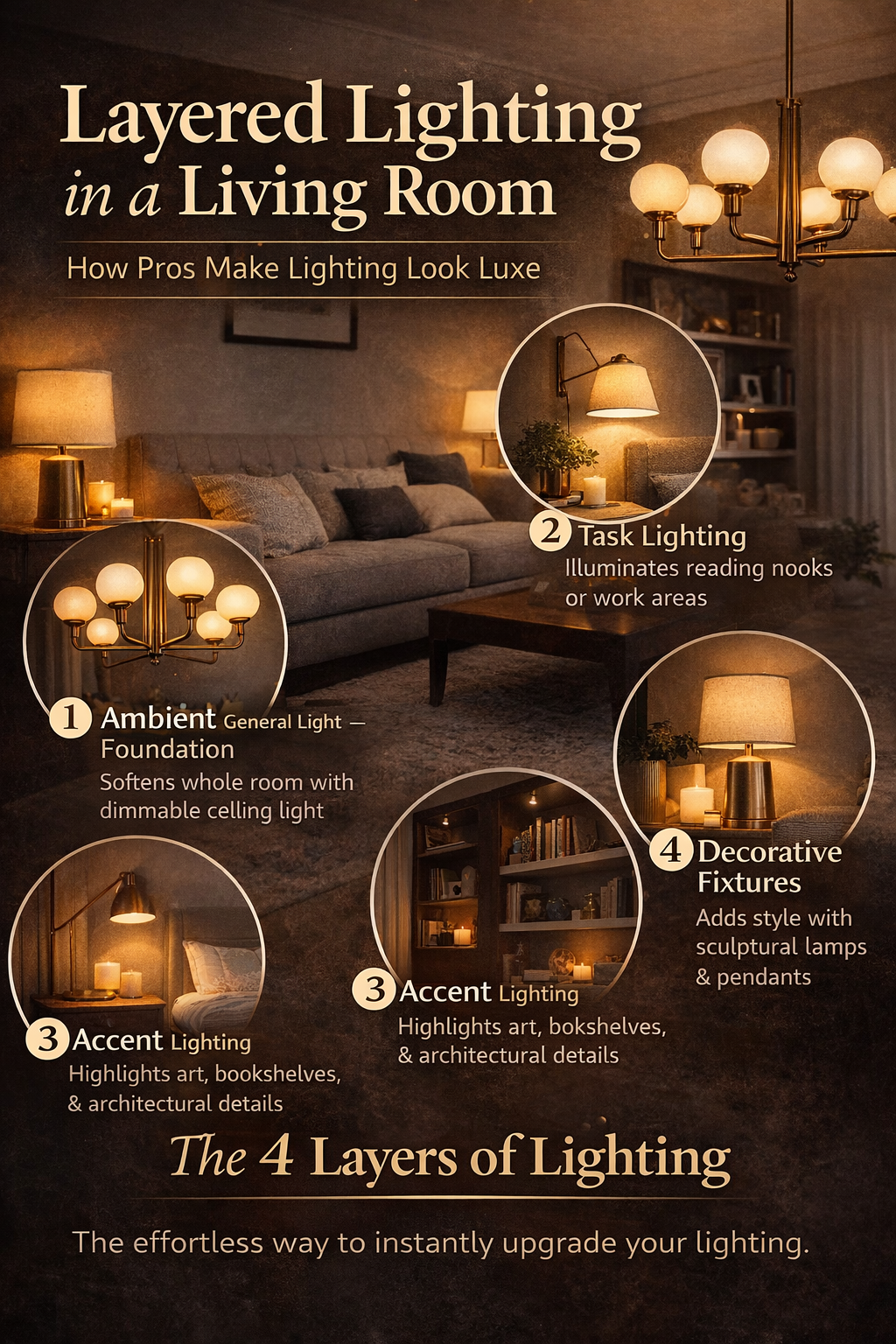
Every designer knows the secret that most homeowners overlook: furniture doesn’t make a room feel
expensive — light does. A layered lighting living room is the single most transformative upgrade
you can give your space. It’s why photographed interiors look so dimensional, so warm, so alive — even
when the furniture itself is modest. Without layered light, even a beautifully furnished room falls completely
flat.
01 — Foundation
What Is Layered Lighting in a Living Room?
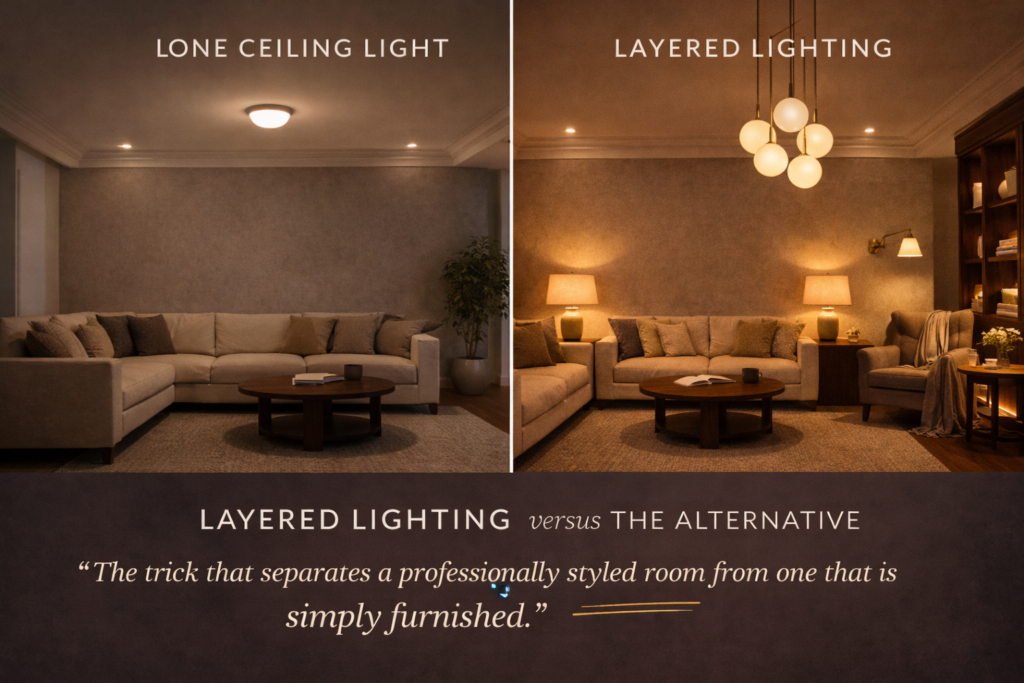
Layered lighting means using multiple, intentionally placed light sources at different heights
and intensities to create depth, warmth, and atmosphere in a room. The opposite of layered lighting is a single
overhead light doing all the work — which is what most homes default to.
A lone ceiling light casts a flat, shadowless glow that makes a room look like a waiting room. It flattens
texture, kills mood, and ages a space. A layered lighting living room, by contrast, has light
coming from multiple levels: from the ceiling, from the walls, from the floor, and from tabletop height. Each
layer has a different job. Together, they create the kind of rich, dimensional atmosphere that makes guests stop
and say, “this room feels incredible.”
“Layered lighting is consistently named the number one trick that separates a professionally styled room from
one that is simply furnished.”
— Architectural Digest
02 — The Framework
The 4 Layers of Lighting — Explained
Interior designers work with four distinct lighting layers. Understanding each one is the foundation of every
great living room lighting scheme.
Layer 1 — Ambient (General) Lighting
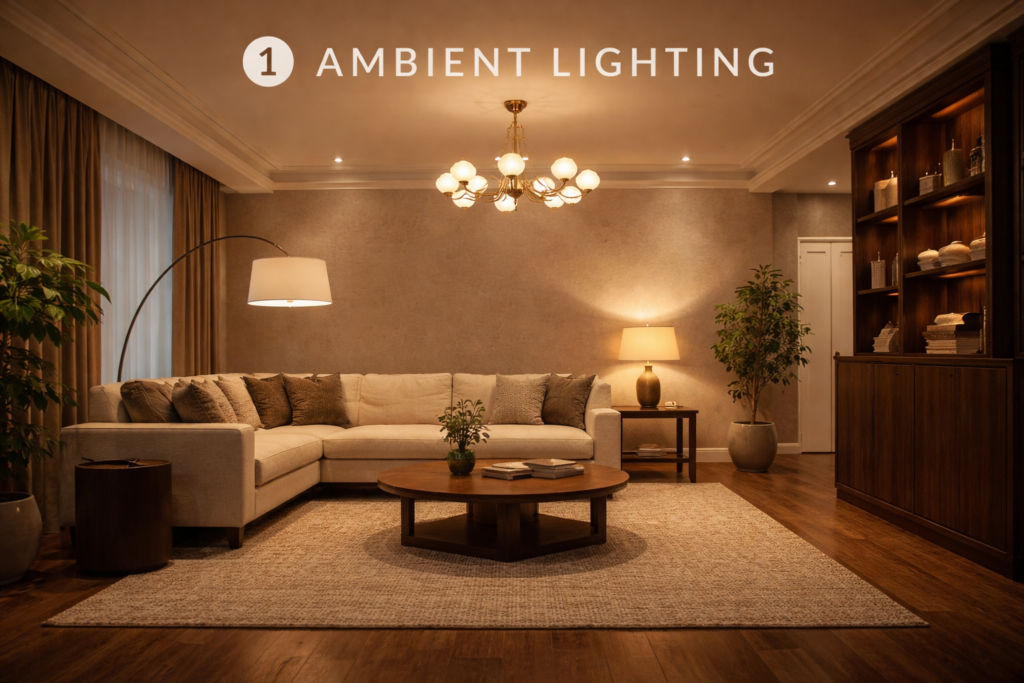
This is your room’s base illumination: the light that allows you to move safely and see the space clearly. In a
living room, ambient light typically comes from a central ceiling fixture or chandelier, recessed downlights, or
a large arc floor lamp used as the primary source.
completely different room from one dialed to 40%. Install a dimmer switch on your main overhead light — it
is the single cheapest, most impactful upgrade you can make.
Layer 2 — Task Lighting
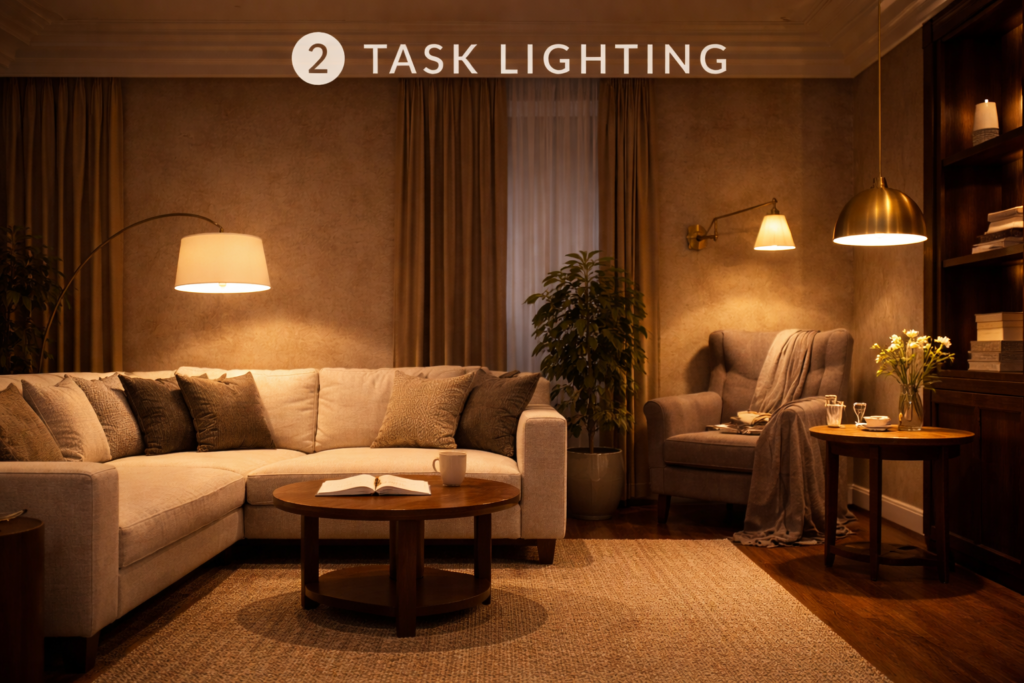
Task lighting is focused, functional light placed where you actually do things. In a living room this
means a reading lamp beside the sofa, a swing-arm wall sconce above an armchair, or a pendant over a side table
used for work. According to the U.S. Department of Energy, well-placed task lighting is also one of the
most energy-efficient choices — you illuminate only where you need it.
Layer 3 — Accent Lighting
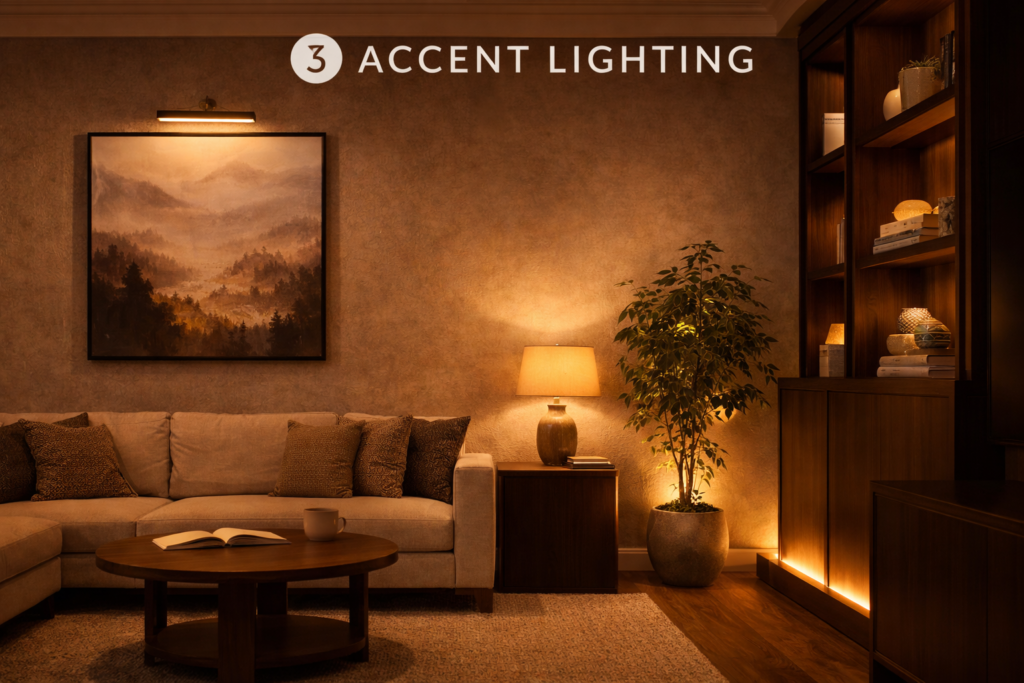
Accent lighting is the designer layer — the one most homeowners skip and the one that makes the biggest
visual difference. Its purpose is to draw attention to something: a piece of art, a textured wall, a beautiful
bookshelf, an architectural detail.
In a living room: directional spotlights or picture lights aimed at wall art, a small decorative lamp inside a
bookshelf, an uplighter behind a large plant, or LED strip lighting running behind a TV console.
Layer 4 — Decorative Lighting
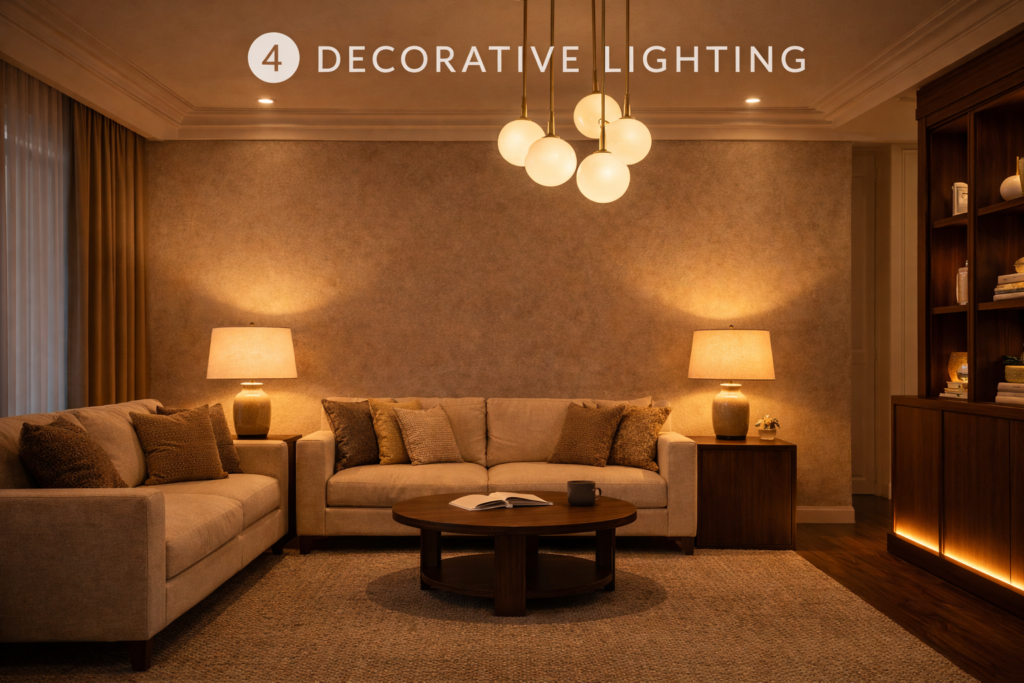
This is the layer that most people don’t think of as “light” at all — it’s the fixtures themselves as design
objects. A sculptural pendant, a pair of matching table lamps with oversized linen shades, a cluster of globe
pendants: these are decorative elements that also produce light. In a layered lighting living room,
decorative fixtures are chosen for what they look like when switched off just as much as when switched
on.
03 — The Process
How to Layer Lighting in Your Living Room: Step by Step
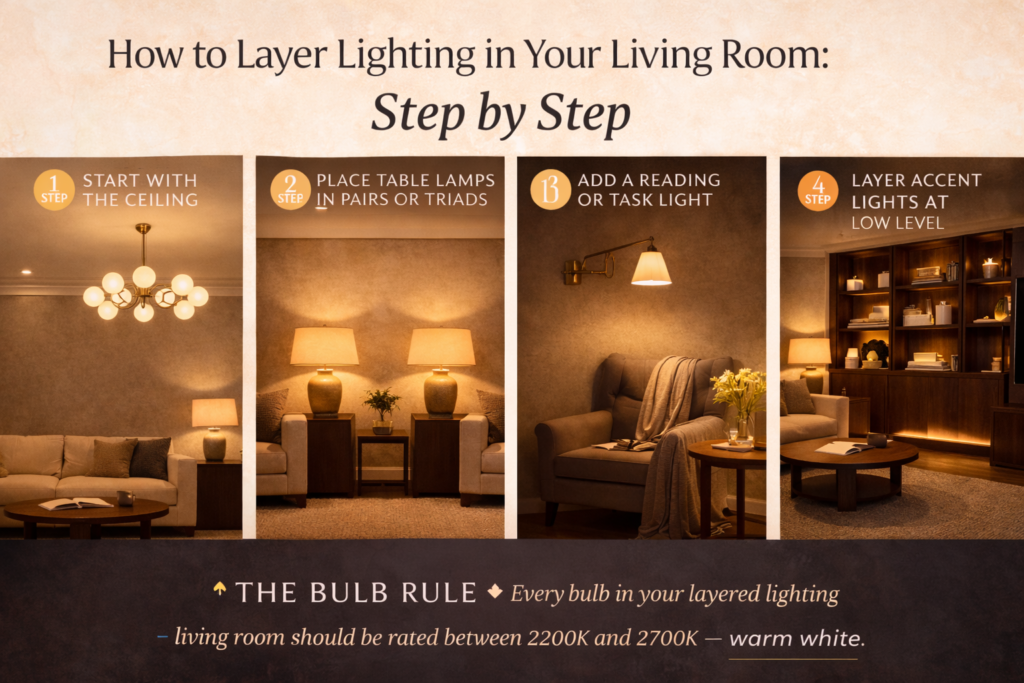
Step 1 — Start With the Ceiling
Identify your primary overhead light source. If you have recessed downlights, install dimmers. If you have a
central pendant or chandelier, make sure it’s on a dimmer circuit. This is your ambient layer.
If your room has no ceiling fixtures and you’re renting, a large arc floor lamp in the corner functions
beautifully as the ambient source.
Step 2 — Place Table Lamps in Pairs or Triads
Two matching table lamps on either side of a sofa — or on opposite ends of the room — create visual
rhythm: a sense of order and intention. The lampshade height should sit at or slightly below eye level
when seated (roughly 58–64 cm from the floor to the base of the shade). Choose shades in linen or silk that
diffuse light rather than direct it downward.
Step 3 — Add a Reading or Task Light
For every seating zone in your living room, introduce a directed task light. A swing-arm floor lamp behind a
reading chair, a sconce mounted beside the sofa — these prevent the room from feeling equally lit everywhere
(which reads as flat) and give each area its own sense of intimacy.
Step 4 — Layer Accent Lights at Low Level
This is the layer that most transforms a living room after dark. Add a warm LED strip behind your TV console, a
small lamp on a bookshelf behind a decorative object, an uplighter in a dark corner, or a candle grouping on the
coffee table. When your ambient is dimmed and your accent lights are on, the room takes on a depth that no
amount of furniture can achieve.
warm white. This Kelvin range replicates the amber tone of candlelight. Anything above 3000K creeps into
cool white territory, which makes skin look grey, wood look plastic, and marble lose its warmth entirely.
04 — The Rule
What Is the 5-7 Lighting Rule?
One of the most practical frameworks for layered lighting in a living room is the 5-7 lighting
rule: in any well-designed room, you should have between 5 and 7 individual light
sources operating at one time.
This number sounds high at first. But count them up in a beautifully designed living room:
The goal is not brightness — it’s distribution. Many small pools of warm light always beat
one harsh overhead flood.
05 — 2025 Trends
New Trends in Living Room Lighting (2025)
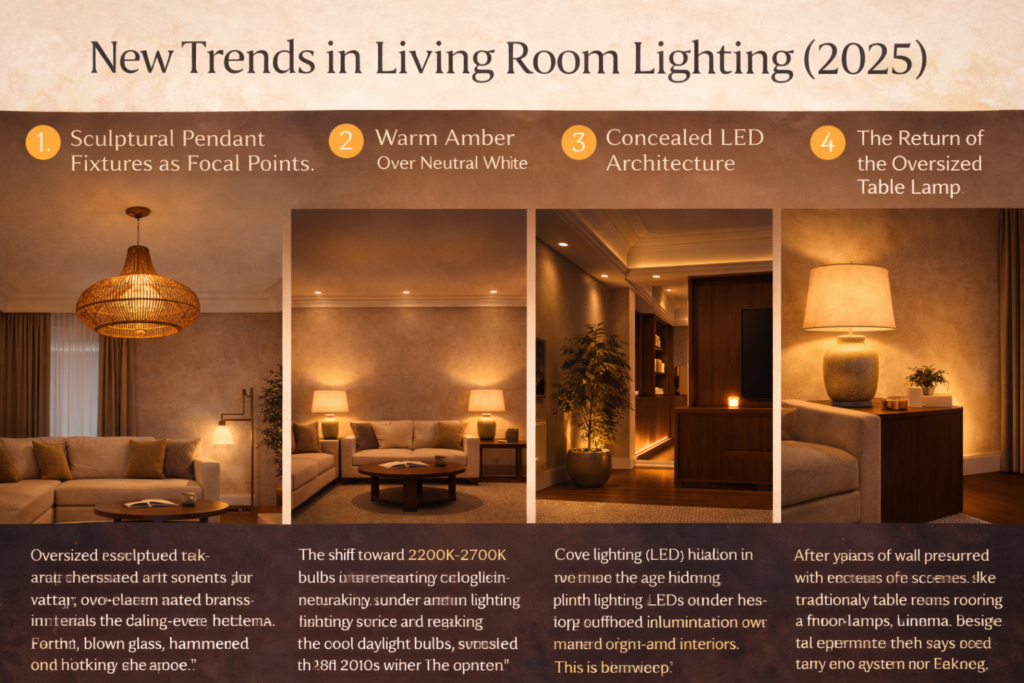
1. Sculptural Pendant Fixtures as Focal Points
The era of the flat flush-mount ceiling disc is over. In 2025, statement pendants — oversized, sculptural,
artisanal — are becoming the centerpiece of living rooms, functioning as ceiling-level art. Woven rattan, blown
glass, hammered brass, and organic ceramic forms are dominating the space.
2. Warm Amber Over Neutral White
The shift toward 2200K–2700K bulbs is accelerating. Designers are actively prescribing amber-warm lighting in
living rooms and rejecting the cool daylight bulbs installed in the 2010s under the guise of “modern.”
3. Concealed LED Architecture
Cove lighting (LEDs hidden in recessed ceiling channels), plinth lighting (LEDs under floating furniture), and
behind-panel illumination are now the markers of truly high-end interiors. The light source is completely hidden
— only the glow is visible.
4. The Return of the Oversized Table Lamp
After years of wall-mounted and recessed dominance, the traditional table lamp is having a major design moment.
Sculptural table lamps with large linen shades are appearing in every luxury interior — often placed on the
floor beside sofas in lieu of a floor lamp.
5. Smart Lighting Scenes
Systems like Lutron Caseta and Philips Hue are now being programmed with named “scenes” — Morning, Afternoon,
Evening, Cinema — that shift the entire room’s color temperature and intensity automatically. This is the
future of the layered lighting living room: dynamic, atmospheric, and entirely effortless.
06 — Common Errors
Layered Lighting Mistakes to Avoid
-
Relying on one overhead light. A single ceiling light at full brightness is visually
aggressive and aesthetically flat. Layer around it, dim it down, and let the other layers do the work. -
All lights at the same height. A room where every source is at eye level or ceiling
level has no vertical drama. Introduce floor-level light — uplighters, low table lamps, LED strips — to
anchor the room and create depth. -
Mixing color temperatures. If half your bulbs are 2700K and half are 4000K, the room
will look incoherent — warm in some zones, clinical in others. Standardize across the entire room. -
Ignoring dimmers. A living room without dimmers is a room without atmosphere. Dimmers
are the single cheapest way to immediately elevate your space and transform it from functional to
living. -
Choosing fixtures for style alone. A stunning lamp that casts harsh, directional light
is still a bad lamp. Always test how the fixture actually illuminates the space — not just how it looks
on a shelf.
07 — Before You Finish
Your Layered Lighting Living Room Checklist
☐ At least 2 table lamps are placed in the room
☐ A task light serves every seating zone
☐ At least one accent light is placed at low level
☐ One decorative fixture anchors the room visually
☐ All bulbs are 2700K or below (warm white)
☐ 5–7 light sources are operational simultaneously
☐ No single light is doing all the work at full brightness
08 — Frequently Asked
Frequently Asked Questions
How to layer lighting in a living room?
Layer your living room lighting by combining four source types at different heights: a
dimmed ambient overhead light, task lamps for reading zones, accent lights aimed at art or shelves, and
decorative fixtures that double as design objects. Aim for 5–7 individual light sources, all at warm white
(2700K or below), with at least one dimmer switch on your main ceiling light.
What are the 4 layers of lighting?
The four layers of lighting are: Ambient (general background illumination,
usually from overhead), Task (focused light for specific activities like reading),
Accent (directional light to highlight art, architecture, or features), and
Decorative (fixtures chosen as design objects that also produce light). A beautifully
layered room uses all four simultaneously, each set at low-to-medium intensity.
What is the new trend in lighting?
The biggest lighting trends in 2025 include sculptural statement pendants as living room
focal points, concealed LED architecture (cove lighting, plinth lighting, behind-panel strips), a strong
shift to very warm amber bulbs (2200K–2700K), oversized artisanal table lamps, and smart lighting scenes
that automatically shift color temperature and brightness for morning, afternoon, evening, and cinema
modes.
What is the 5-7 lighting rule?
The 5-7 lighting rule states that any well-designed living room should have between five and
seven individual light sources operating simultaneously — such as a dimmed ceiling fixture, a floor lamp,
two table lamps, a candle grouping, an LED accent strip, and a shelf lamp. The purpose isn’t brightness;
it’s distribution. Many small, warm light pools create far more atmosphere than one bright overhead
source working alone.